Concrete Slab Foundations in Marble Falls, TX: Homeowner Guide
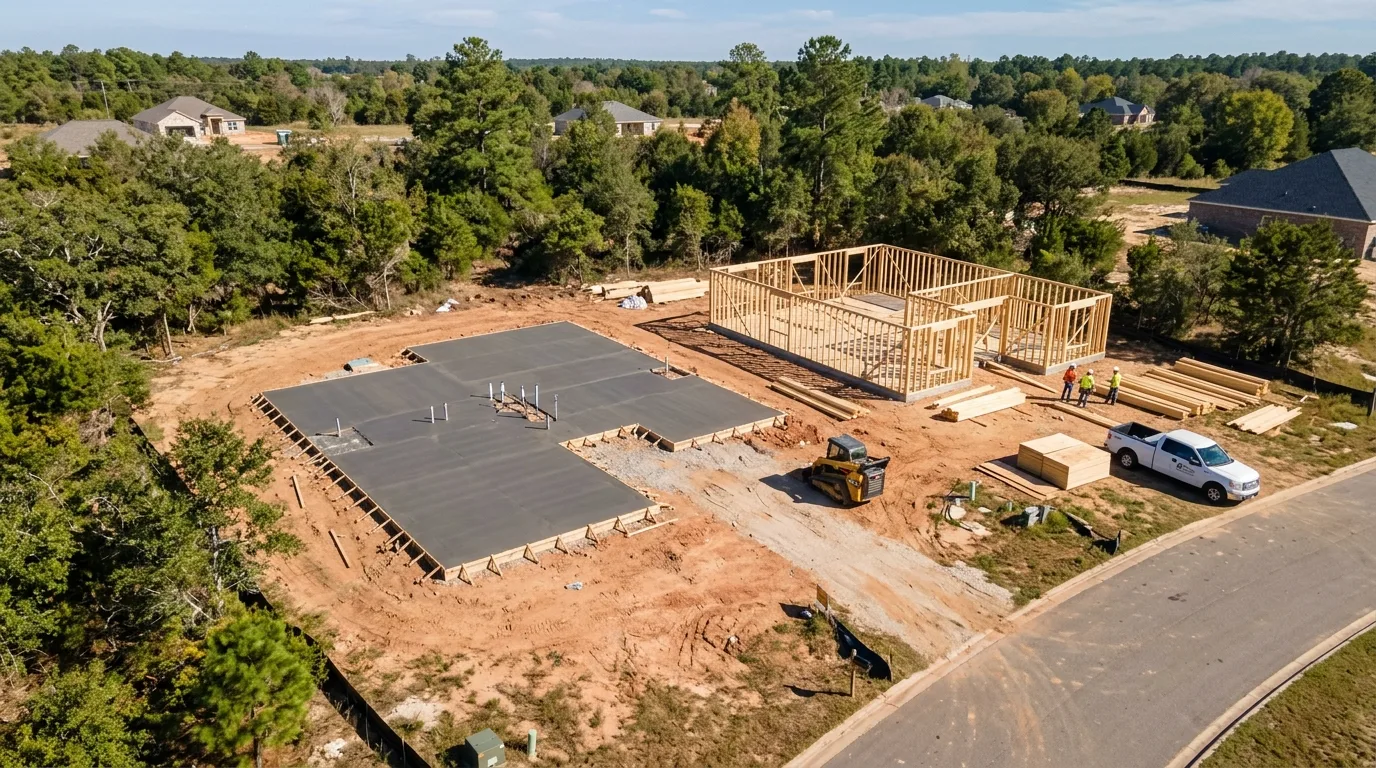
When you’re building in Marble Falls or replacing a failing foundation, the decisions you make about your concrete slab affect your home for the next 50 years. Most homeowners never think about their foundation until something goes wrong — and by then, repair costs start in the thousands. This guide covers what you need to know before you pour: how slab foundations are designed for Burnet County conditions, what differentiates a post-tension slab from conventional reinforcement, what the permit process looks like, and what questions to ask any contractor bidding your foundation work.
Foundation Slab Project in Marble Falls?
Get honest engineering guidance and a free estimate. Marble Falls Concrete handles everything from sub-grade prep to final pour. Call (888) 376-0955.
Why Marble Falls Slab Foundations Are Different From Other Regions
Concrete slab foundation design in most of the country is relatively standardized — pour a 4-inch slab with rebar or wire mesh on a prepared sub-grade and it will perform adequately for decades. In Marble Falls and throughout Burnet County, that approach consistently fails because it ignores the defining characteristic of the local soil: expansive black gumbo clay that moves with moisture changes.
Every spring, Marble Falls homeowners throughout neighborhoods like Rocky Creek Ranch and the subdivisions along US-281 north of downtown discover new cracks in their walls, sticking doors, and uneven floors — the telltale signs of a concrete slab that has moved. This isn’t a construction defect; it’s the predictable consequence of building on reactive clay soil without a foundation system designed for clay’s behavior. Statewide, Texas has more foundation movement issues than any other state — and Burnet County’s soil places it firmly in the high-risk category.
Slab Foundation Design Types Used in Marble Falls
Post-tension monolithic slab: The current standard for residential construction on Burnet County clay. The slab is poured monolithically — foundation beams and floor slab in one continuous pour — over a grid of galvanized steel cables embedded in plastic sheaths. After the concrete cures to sufficient strength (typically 2,000 PSI at 3 days, 3,000 PSI at 28 days), the cable ends are tensioned by hydraulic jacks, putting the entire slab under compression. This compressed state allows the slab to act as a unified rigid plate, resisting differential movement when soil conditions vary across the footprint.
Post-tension slabs for residential construction in Marble Falls are designed to the Post-Tensioning Institute’s (PTI) standard DC10.5, which classifies soil conditions and specifies reinforcement and beam depth for each classification level. Burnet County’s clay typically falls in PTI Level 3 or 4 — the more demanding categories.
Conventional reinforced slab-on-grade: Uses deformed steel rebar (#4 or #5 bar) in a grid pattern rather than post-tension cables. Adequate for accessory structures, garages, and outbuildings where the cost of post-tension engineering isn’t warranted. Less resistant to differential movement than post-tension for the same slab thickness. On Marble Falls clay, conventional slabs for primary residences require heavier rebar schedules and deeper perimeter beams than in more stable soil conditions.
Drilled pier and grade beam: Concrete caissons are drilled to bedrock or stable material below the active clay zone — typically 10–20 feet in the Marble Falls area depending on local geology. A reinforced concrete grade beam ties the pier tops together, and the floor structure is framed above grade. Eliminates the direct clay-slab interface entirely. Used for hillside lots throughout the Marble Falls area, particularly for custom homes in the terrain above Lake Marble Falls.
What Foundation Plan Review Requires in Marble Falls
The City of Marble Falls requires building permits for all new foundation construction, additions, and foundation replacements within city limits. Foundation plans must bear the stamp of a Design Professional — a licensed professional engineer (P.E.) or registered architect. This isn’t a bureaucratic formality; it’s the mechanism that ensures the foundation design accounts for the site’s actual soil conditions and loads.
The permit process in Marble Falls operates through the city’s MGOConnect portal at mygovernmentonline.org. Submittal requirements include foundation plan drawings at 1/4-inch scale, soil report or site classification documentation, load calculations, and a stamped design specification. Review time for residential foundation permits typically runs 5–10 business days. Inspections are required at sub-grade (before concrete placement), reinforcement (before pour), and final.
For projects outside city limits in unincorporated Burnet County, the county permit office at 220 S. Pierce Street in Burnet handles the permit process — similar requirements but a different submittal portal.
Practical Uses: Slab Types by Application
- New primary residence in Marble Falls city limits: Post-tension slab, PTI classification performed, engineered plan stamped by licensed P.E., full permit through MGOConnect.
- Garage slab (attached or detached): Conventional reinforced slab at 5–6 inches, #4 rebar at 18-inch centers, compacted gravel base, control joints at 10-foot maximum intervals.
- Home addition tied to existing post-tension slab: Requires engineer to review existing cable layout and design a tie-in detail that doesn’t compromise existing cables. Critical step often skipped by contractors unfamiliar with post-tension work.
- Workshop or agricultural building: Conventional reinforced slab at 4–5 inches, fiber mesh or #4 rebar at 24-inch centers. Permit required even for agricultural outbuildings within city ETJ.
- Accessory dwelling unit (ADU): Post-tension slab recommended on clay sites; minimum PTI Level 2 design. Full permit process as primary residence.
- Foundation replacement on existing home: Mudjacking or void-fill for minor heave on post-tension slabs; partial or full replacement for severely damaged slabs. Engineering evaluation required before any structural repair.
Foundation Questions in Marble Falls or Burnet County?
We coordinate engineering, permits, and sub-grade preparation for foundation slabs throughout the area. Call (888) 376-0955.
Sub-Grade Preparation for Burnet County Clay
No foundation design performs as engineered without proper sub-grade preparation. The standard protocol for Marble Falls clay sites includes:
- Proof rolling — a loaded vehicle driven over the sub-grade to identify soft spots and voids that need correction before forming begins
- Moisture conditioning — adjusting the clay moisture content toward optimum before compaction (neither too dry nor too wet)
- Compaction — achieving 95% standard Proctor density at each lift, verified by nuclear density gauge testing
- Select fill or gravel base — placing 4–6 inches of select granular fill or crushed limestone between the clay and the concrete slab to buffer seasonal moisture movement
- Vapor barrier — 6-mil or 10-mil polyethylene sheeting under the slab to prevent ground moisture migration upward through the concrete
Each of these steps is a quality control checkpoint. Contractors who skip proof rolling, don’t test compaction, or omit the vapor barrier are producing slabs that will perform below design intent regardless of how good the concrete is.
Cost Factors for Foundation Slabs in Marble Falls
Basic flatwork like garage slabs average around $3 per square foot installed in Marble Falls. Engineered foundation slabs — post-tension designs with proper site preparation and permit coordination — run higher due to engineering fees ($500–$2,000), post-tension cable materials, stressing labor, and the deeper perimeter beams required on clay sites. Across Burnet County, these costs are consistent.
The most important cost perspective: foundation failure remediation costs $10,000–$40,000+ depending on severity. The marginal cost of building the foundation correctly the first time is trivial by comparison. Our concrete slabs service page has a full breakdown of what’s included in a properly engineered foundation slab project in Marble Falls.
Frequently Asked Questions
Does every concrete slab in Marble Falls need to be engineered?
Structural slabs — home foundations, garage foundations for permitted structures, and any slab designed to bear structural loads — require engineer-stamped plans for the City of Marble Falls permit. Flatwork like driveway slabs, patio slabs, and walkways are typically designed to standard industry specifications without a separate engineering fee, though they still require permits within city limits.
How do I find out what type of foundation I have?
For homes built in the last 30 years, post-tension is the most likely design. Look for the cable end caps (small circular stainless steel plugs, typically at the slab edges), which are the giveaway. Older homes may have conventional reinforced slabs. If you’re planning any work that cuts through or impacts the slab — plumbing modifications, additions, slab penetrations — you need to know which type you have before any work begins. Cutting a post-tension cable without knowing its location can release hundreds of pounds of tension instantaneously.
Can I pour a new slab adjacent to my existing post-tension foundation?
Yes, but the tie-in between new and existing requires engineering review. The existing cable locations and the direction of stressing must be known before the adjacent slab can be designed. We coordinate with licensed P.E.s for all foundation tie-in work as part of our project scope.
Concrete Slab Foundations Built for Burnet County Clay
Call Marble Falls Concrete at (888) 376-0955. Full engineering coordination, permit handling, and sub-grade preparation included.
Related: