Marble Falls Clay Soil and Your Concrete Foundation: TX Guide
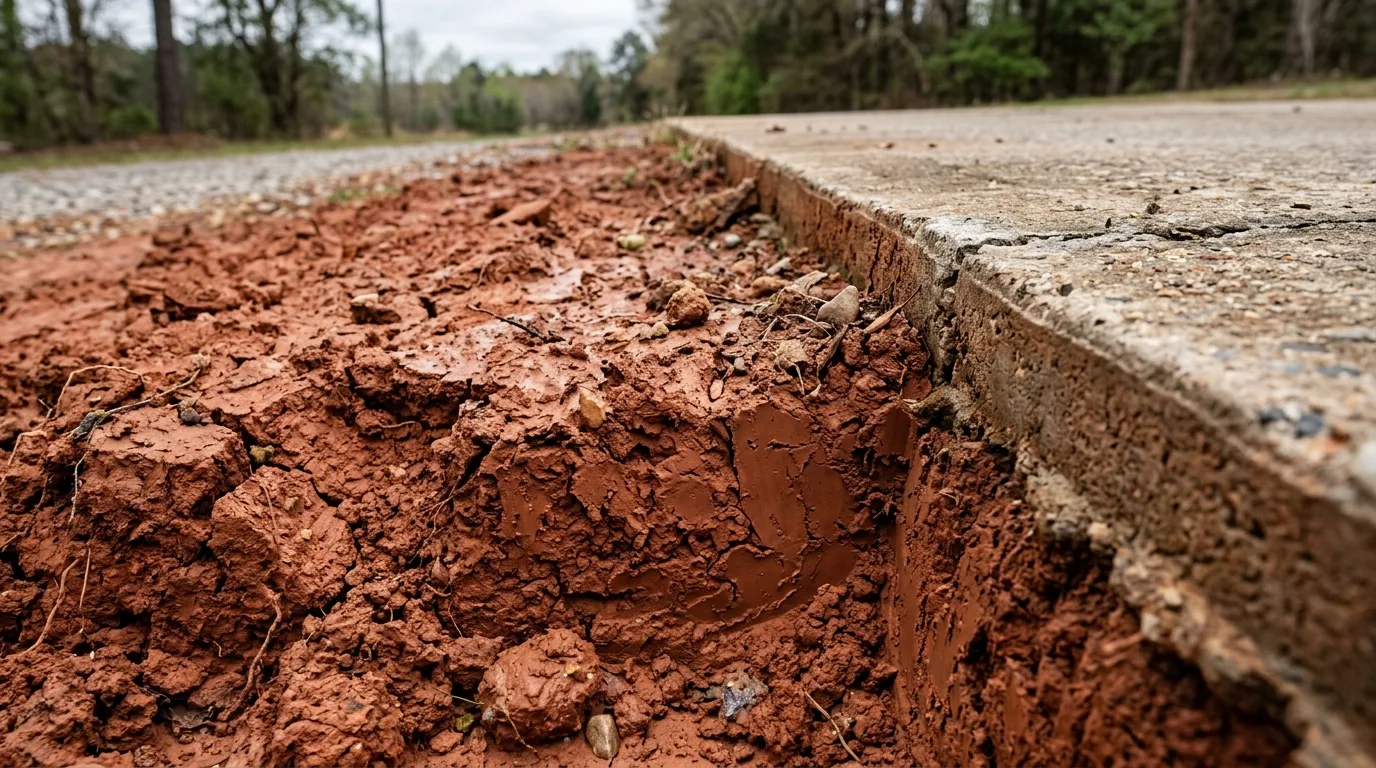
Burnet County’s expansive clay ranks in the top tier of problem soils for concrete in the entire state of Texas — a fact that surprises many homeowners moving to the Marble Falls area from regions with sandy or decomposed granite sub-grades. The Texas Commission on Environmental Quality classifies the “black gumbo” clay found throughout this region as having one of the highest shrink-swell plasticity indexes in the state, which translates directly into foundation movement, cracked slabs, and structural distress when concrete isn’t specifically engineered for local soil conditions. In this post, we cover how this soil type behaves, why it causes the problems it does, what foundation designs actually work here, and what Marble Falls homeowners need to know before building or buying on clay.
Foundation or Slab Questions in Marble Falls?
Get an honest assessment from a contractor who knows Burnet County clay soils. Call (888) 376-0955.
Why Marble Falls Expansive Clay Is Particularly Challenging
Expansive clay minerals — primarily montmorillonite and smectite — have a crystal lattice structure that absorbs water molecules between clay plates, causing the entire soil mass to swell. When that water leaves during dry periods, the lattice collapses and the soil contracts. The volume change in Burnet County’s black gumbo can reach 10–15% with seasonal moisture swings — meaning a 10-foot column of clay soil can expand or contract by more than an inch per foot of depth.
For residential foundations in the Marble Falls area, this creates differential movement: one side of a house foundation sits on soil that absorbed more rain from a downspout or irrigation system, while the other side sits on drier, contracted clay. The slab pivots around this uneven support, causing the interior symptoms that homeowners recognize — cracked drywall, sticking doors, gaps at window frames, and visible cracks in the concrete slab itself.
The seasonal pattern amplifies the problem. Marble Falls receives the bulk of its 33 inches of annual rain in spring and early summer, with June being the wettest month at 4.6 inches. The following August, when highs regularly reach 95–96°F, drives rapid soil drying. The foundation that swelled in June contracts in August — then swells again the following spring. Over five to ten years, this cycle accumulates differential movement that no residential concrete slab can absorb without reinforcement specifically designed for it.
Types of Foundation Designs Used in Burnet County
Post-tension slab: The dominant foundation system in areas with expansive clay throughout Central Texas. After the concrete is poured over a grid of steel cables, those cables are tensioned by hydraulic jacks, putting the concrete under compression. This pre-stressed state allows the slab to move as a unified rigid plate rather than cracking at individual stress points. Post-tension foundations are the standard recommendation for new residential construction on Burnet County clay.
Conventional reinforced slab: Uses #4 or #5 rebar grids rather than post-tension cables. Adequate for accessory structures and outbuildings, and for residential slabs when combined with proper soil preparation. Requires heavier rebar schedules (closer spacing) to provide equivalent resistance to differential movement compared to post-tension designs.
Pier-and-beam foundation: Elevates the floor structure above the clay on concrete piers drilled to stable sub-grade or bedrock. Eliminates direct contact between the living space structure and the reactive clay. Used on sloped Hill Country lots where drilling to rock is practical. More expensive than slab construction but eliminates slab-on-grade movement entirely.
Drilled pier foundation: Concrete caissons drilled 10–20 feet into stable material below the active clay zone. The foundation structure sits on these piers rather than the clay surface. Used for custom homes and hillside lots throughout the Marble Falls area, including properties near Inks Lake State Park and along the Colorado River corridor.
Practical Uses: Foundation Design by Application
- New residential home on flat lot in Marble Falls: Post-tension slab with perimeter grade beams to 18-inch depth, PTI design Level 3 soil movement, vapor barrier below slab.
- Detached garage or workshop: Conventional reinforced slab at 5–6 inches, #4 rebar at 18-inch centers, compacted gravel base, control joints at 10-foot intervals.
- Home addition tied to existing slab: New slab engineered to match existing post-tension design; requires engineer to review the existing cable layout before tie-in.
- Properties on rocky Hill Country terrain (Cottonwood Shores, lakefront): Pier-and-beam or drilled pier system taking advantage of rock proximity to eliminate clay interface entirely.
- Commercial slab in Marble Falls commercial corridor: 6-inch minimum thickness, engineer-stamped design, compacted select fill to replace expansive clay within active zone depth.
- Accessory dwelling unit or guest house: Assess depth to stable sub-grade; on deep clay profiles, post-tension design provides best long-term performance at moderate cost premium over conventional.
How Soil Prep Works Before the Pour
Planning a Foundation Slab in Marble Falls?
Marble Falls Concrete handles full foundation projects — engineering coordination, permits, and sub-grade prep. Call (888) 376-0955.
Before any foundation slab pours in Marble Falls, proper soil preparation is the most important line item in the project. This includes: (1) Proof rolling the sub-grade to identify soft zones; (2) Removing or replacing any organic material or unsuitable fill; (3) Placement of select fill or crushed limestone base at specified depth and lift thickness; (4) Compaction testing to verify 95% standard Proctor density at each lift; (5) Installation of vapor barrier before reinforcement placement.
Skipping or shortcutting any of these steps shifts the cost forward — from a controlled construction cost to an uncontrolled remediation cost years later. Foundation repair on a slab that has experienced significant differential movement can cost $10,000–$40,000 or more, depending on the severity of heave and whether interior finishes and structural walls have been affected. Proper sub-grade prep costs a fraction of that.
Cost Factors for Foundation Slabs in Marble Falls
Basic concrete pads in Marble Falls average $3 per square foot installed for straightforward flatwork applications. Foundation slabs for residential or commercial structures requiring engineered design, engineer-stamped plans, and post-tension specifications are higher — the engineering fee alone runs $500–$2,000 depending on complexity, and the post-tension cable materials and stressing labor add $0.75–$1.25 per square foot over conventional reinforcement. Across Burnet County, these costs are consistent for comparable applications.
The economic calculus is straightforward: the cost of doing the foundation correctly at construction time is always less than the cost of repairing differential settlement later. For more detail on foundation slab design and construction in Marble Falls, read our concrete slabs service page.
Frequently Asked Questions
How do I know if my Marble Falls home is on expansive clay?
The most reliable method is a geotechnical investigation with soil borings, but most of the Marble Falls area in Burnet County sits on expansive clay — particularly the flatter terrain. Homes near the Meadowlakes community and in the valley areas between US-281 and the lakefront are most commonly on deep clay profiles. If your home has sticking doors, diagonal cracks in drywall from window corners, or visible slab cracks, clay soil movement is the likely cause. Read our guide on 5 signs your concrete foundation needs attention for a fuller diagnostic checklist.
Can I repair a slab that has already moved due to clay soil?
It depends on how much movement has occurred and whether the cause can be controlled. Minor heave on a post-tension slab often stabilizes once drainage around the foundation is corrected — eliminating the moisture source that’s saturating the clay on one side. Significant differential movement on a conventionally reinforced slab may require slab replacement with improved design. We always assess the underlying cause first.
Does sealing the soil or using moisture barriers help?
Maintaining consistent soil moisture — through even irrigation distribution, proper grading to drain water away from the foundation perimeter, and planting drought-tolerant landscaping — reduces the amplitude of moisture swings that drive clay expansion and contraction. Vapor barriers under slabs prevent ground moisture from migrating upward through the concrete but don’t address lateral moisture variation around the perimeter.
Foundation Work Done Right for Burnet County Clay
Call Marble Falls Concrete at (888) 376-0955. Engineered foundation slabs, full permit coordination, and sub-grade prep that actually addresses the soil.
Related: