Concrete vs. Asphalt Driveways for Texas Hill Country Homes
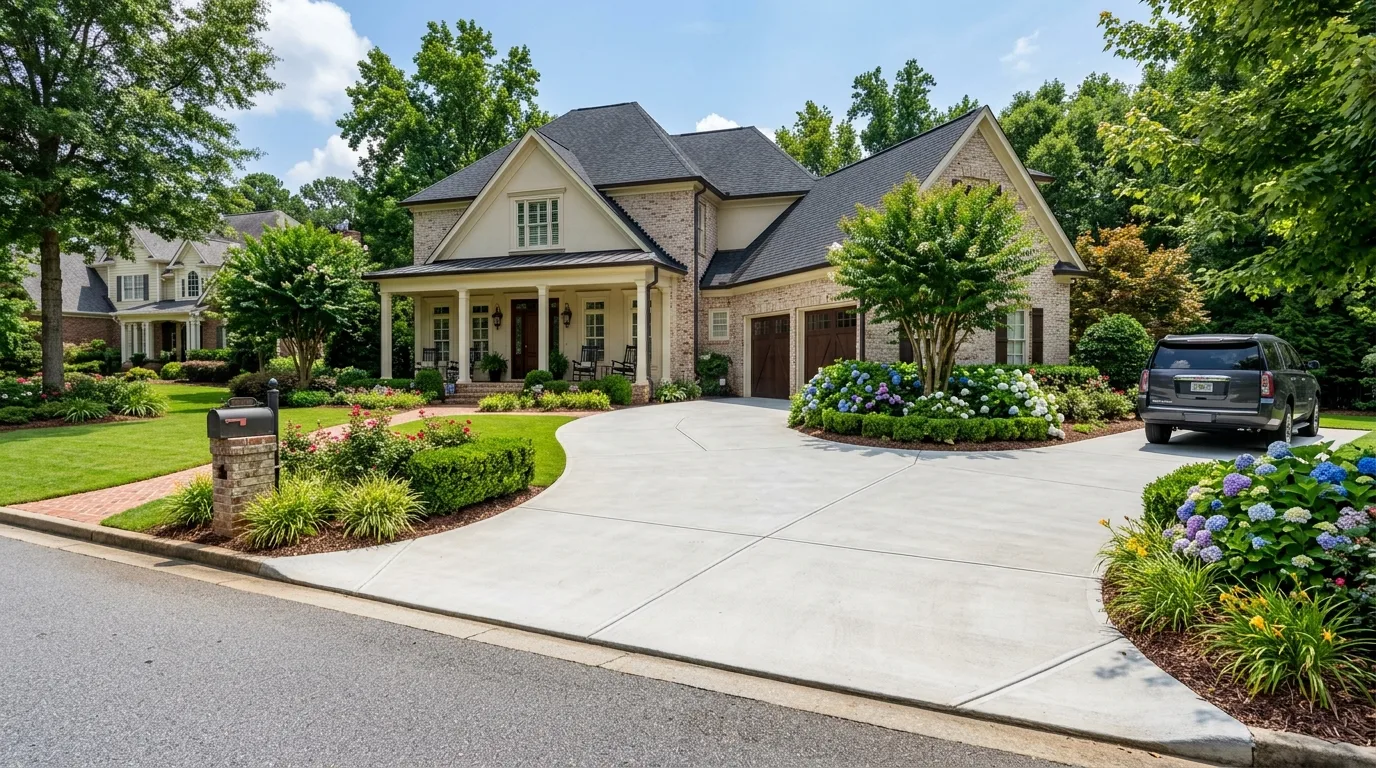
Every summer, Marble Falls homeowners learn the hard way what Texas heat does to an asphalt driveway — softening, tracking, and rutting under parked vehicles on the 95–96°F days that define August in the Hill Country. Asphalt is the cheaper surface at installation, and that initial cost advantage is real. But in the Marble Falls climate, with its combination of intense summer heat, expansive clay soils, and occasional freeze-thaw cycles, the comparison shifts significantly when you account for total cost of ownership over 20 years. In this post, we compare concrete and asphalt driveways across five factors that matter most to Burnet County homeowners: installation cost, heat performance, durability, maintenance requirements, and resale value.
Concrete Driveway Estimates in Marble Falls
Find out what a concrete driveway costs for your specific property. Free estimates — call (888) 376-0955.
Why This Comparison Matters for Marble Falls Specifically
Most concrete versus asphalt comparisons are written for the national market, where average climate conditions don’t punish either surface as aggressively as the Texas Hill Country does. Marble Falls is a specific climate environment: 100+ days over 90°F per year, black gumbo clay that expands and contracts seasonally, 33 inches of annual rain concentrated in spring and early summer, and roughly 38 below-freezing nights in winter. Both concrete and asphalt perform differently here than they do in a temperate climate — and the performance gap between them is wider.
The Northwood subdivision in Marble Falls and the lakefront neighborhoods near Granite Shoals are full of both concrete and asphalt driveways installed in the same period. Walking those streets in August tells the story clearly: asphalt driveways show surface softening, edge crumbling, and — where clay soil movement has occurred — heaved sections. Concrete driveways on the same street show their age differently — usually in the form of control joint cracking or surface scaling if original installation was poor — but structurally maintain their grade and load capacity far longer.
Factor 1: Installation Cost
Asphalt: $3–$5 per square foot installed in the Marble Falls area for a standard 2–3 inch asphalt surface on a gravel base. A 600-square-foot driveway costs $1,800–$3,000.
Concrete: $6–$10 per square foot installed for standard broom-finish concrete. The same 600-square-foot driveway costs $3,600–$6,000.
Verdict at installation: Asphalt is clearly cheaper upfront — typically 40–50% less than concrete. This initial cost advantage is real and should be acknowledged honestly. It’s the primary reason homeowners in Marble Falls choose asphalt despite its longer-term limitations.
Factor 2: Performance in Texas Heat
Asphalt: Softens significantly in temperatures above 85°F. Marble Falls sees 100+ days per year exceeding 90°F, meaning asphalt is in a softened state for roughly a third of the year. Parked vehicles, RV tires, and heavy equipment leave impressions. Petroleum-based binder breaks down under prolonged UV and heat exposure, accelerating surface oxidation and brittleness.
Concrete: Concrete does not soften in heat. Surface temperature is higher than asphalt in direct sun (concrete absorbs less heat but radiates it longer), but structural integrity is unaffected. In Marble Falls’s summer heat, proper wet curing during installation is critical to full strength development — but once cured, concrete performs thermally throughout the Texas range.
Verdict in Texas heat: Concrete is the clear winner for driveway performance in Marble Falls’s climate. Asphalt’s softening behavior in summer heat is a permanent limitation in this region.
Factor 3: Durability and Lifespan
Asphalt: 15–20 year lifespan in the Marble Falls climate with regular maintenance. Burnet County’s clay soil movement and temperature cycling accelerate oxidation and surface degradation. Cracks appear earlier than in more temperate climates.
Concrete: 30–50 year lifespan with proper base prep, reinforcement, and periodic sealing. The critical factor is the initial installation quality — particularly sub-base preparation for Burnet County clay soils. A well-built concrete driveway outlasts two or three asphalt replacements.
Verdict on durability: Concrete wins decisively. The lifespan difference is so significant that the 20-year total cost of ownership almost always favors concrete even after accounting for the higher installation cost.
Practical Uses: When Each Surface Makes Sense
- Short-term ownership or tight budget: Asphalt’s lower installation cost makes sense if you’re selling within 5 years or the capital outlay is genuinely the constraint.
- Long-term ownership in Marble Falls: Concrete is the economically rational choice when you factor in resealing costs, eventual asphalt replacement, and the clay soil behavior that degrades both surfaces — but punishes asphalt more severely.
- Heavy vehicle use (RVs, trailers, heavy trucks): Concrete is the only viable option in the Marble Falls climate. Asphalt under RV tires in August heat will indent and deform.
- Lakefront and resort properties: Concrete. The aesthetic appeal and property value association with concrete surfaces matters more in premium Horseshoe Bay and lakefront communities, where asphalt can signal deferred maintenance.
- Rental properties with budget constraints: Asphalt can be a defensible choice for rental properties where initial cost minimization is the priority and the property will be sold or redeveloped within 15 years.
- New construction: Concrete, consistently. The marginal cost over asphalt at initial construction is far smaller as a percentage of total project cost, and you’ll never replace it.
Factor 4: Maintenance Requirements
Asphalt: Requires sealcoating every 3–5 years to prevent oxidation and surface breakdown. Cracks require filling annually or they widen rapidly under Texas heat and freeze-thaw cycling. Major cracks and edge failures require patching. Total lifecycle maintenance cost over 20 years typically runs $1,500–$3,000 for a standard residential driveway.
Concrete: Requires sealing every 3–5 years to protect surface from UV and moisture penetration. Control joint caulk needs replacement every 5–7 years as it weathers. Total lifecycle maintenance over 20 years typically runs $500–$1,200. For specific guidance on concrete maintenance in Texas heat, see our concrete driveway maintenance guide.
Verdict on maintenance: Concrete requires less frequent and less expensive maintenance over its lifetime. The sealcoating requirement alone makes asphalt’s lifetime maintenance cost nearly equivalent to concrete’s, while the surface is also being replaced at the 15–20 year mark.
Factor 5: Resale Value
Concrete driveways consistently add more to property values than asphalt, particularly in premium markets like Horseshoe Bay and Marble Falls lakefront properties. Appraisers and buyers recognize concrete as a higher-quality, longer-lasting surface. Asphalt driveways near end of life are often noted as deferred maintenance items in home inspections, while aging concrete driveways with normal control-joint cracking are typically not flagged.
20-Year Value Comparison for Your Marble Falls Property
Talk to Marble Falls Concrete about which surface makes sense for your specific situation. Call (888) 376-0955.
The 20-Year Cost Comparison
For a standard 600-square-foot driveway in Marble Falls:
- Asphalt: $2,400 installation + $2,000 lifecycle maintenance + $2,400 replacement at year 15–20 = ~$6,800 total over 20 years
- Concrete: $4,800 installation + $800 lifecycle maintenance = ~$5,600 total over 20 years
This simplified analysis shows why concrete almost always wins on total cost for Marble Falls homeowners who stay in their homes. The only scenario where asphalt wins economically is a short ownership period of 5 years or less — and even then, the resale value difference may offset the cost advantage.
Frequently Asked Questions
Does asphalt work at all in the Texas Hill Country?
Asphalt can work in Marble Falls for applications where performance requirements are modest and short-term cost is the priority — a back-of-property parking area, a rarely-used secondary drive. For main residential driveways, the summer heat performance and clay soil behavior in Burnet County make concrete the more sensible long-term investment.
What about the environmental impact of each material?
Asphalt uses petroleum products in its binder, which depletes over time (driving the reseal requirement) and introduces hydrocarbons into runoff during rain events. Concrete is essentially inert. Both materials can be recycled at end of life, though concrete recycling (crush and use as base material) is more straightforward than asphalt recycling.
Does concrete crack more than asphalt?
Concrete cracks at control joints — those tooled or saw-cut lines you see across every concrete driveway. These joints are intentional: they direct minor cracking to predetermined lines rather than random fractures. Asphalt cracks randomly everywhere as it ages and doesn’t benefit from controlled joint placement. Read more in our concrete driveway service page.
The Right Driveway Surface for Your Marble Falls Home
Marble Falls Concrete provides free estimates for concrete driveways throughout Burnet County. Call (888) 376-0955 today.
Related: