Repair vs. Replace: Your Concrete Driveway in Marble Falls, TX
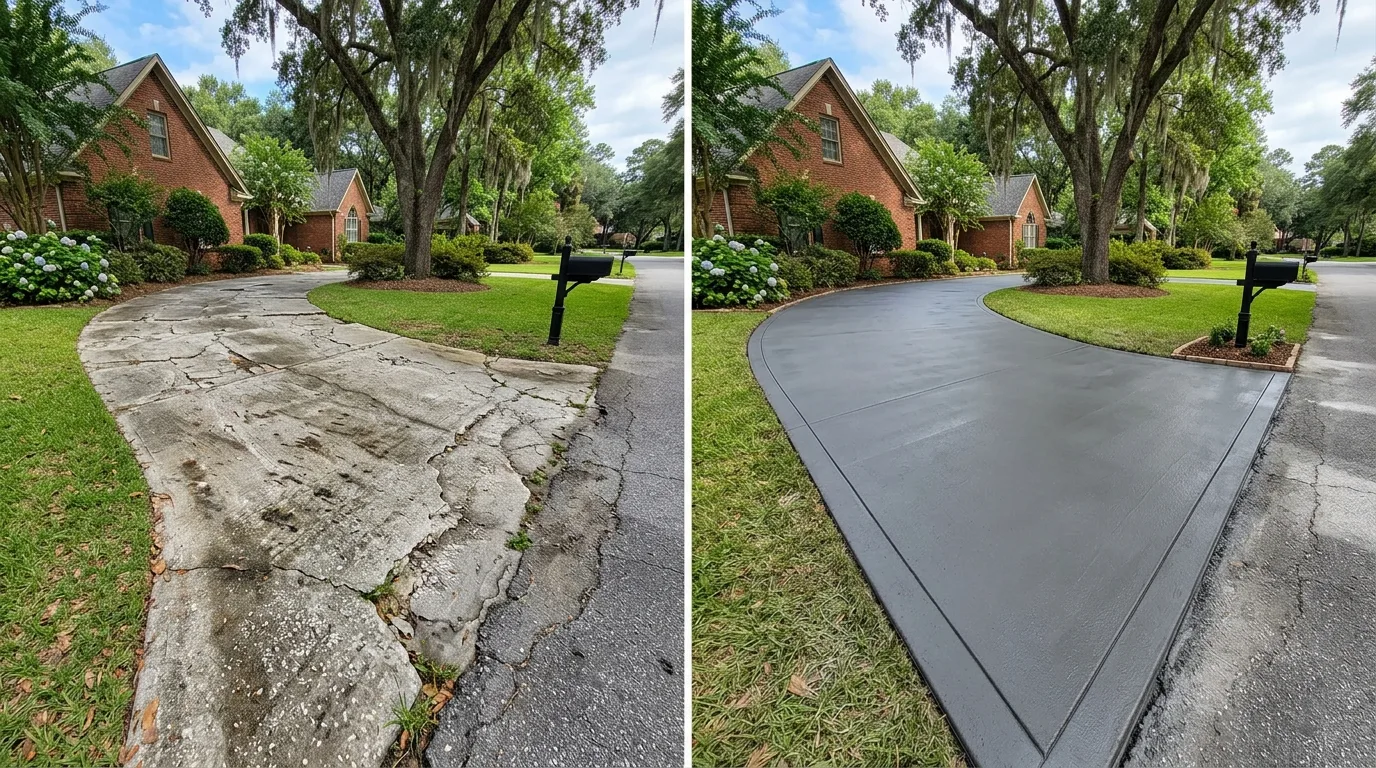
Should you repair or replace your concrete driveway in Marble Falls? It’s the question most homeowners ask after spotting cracking or spalling in their flatwork — and the honest answer depends on factors that most online guides don’t address for Texas Hill Country conditions. In this post, we cover how to assess concrete driveway damage, which damage types respond to repair, which require replacement, and how Burnet County’s expansive clay soils affect both the diagnosis and the treatment. By the end, you’ll have a clear framework for making this decision without overpaying for a replacement you don’t need — or wasting money on a repair that’s guaranteed to fail.
Free Concrete Assessment in Marble Falls
Not sure if your driveway needs repair or replacement? We'll give you an honest evaluation. Call (888) 376-0955.
Why This Decision Is Harder in Marble Falls Than Most Places
Concrete repair guidance written for the general market often misses the local factor that changes everything in Burnet County: the expansive clay soil. In most regions, a crack in a driveway is surface damage — caused by thermal cycling, heavy loads, or construction defects — and can be filled without addressing anything underneath. In Marble Falls, many driveway cracks are symptoms of soil movement beneath the slab, and a surface-only repair on a slab that’s actively moving will fail within one or two seasons.
The critical distinction between repairable and replace-worthy concrete damage in Marble Falls often comes down to whether the clay soil beneath the slab is the cause. That’s why the assessment process must start with the question: is this slab moving? If the answer is yes, the approach changes — not necessarily to full replacement, but to a root-cause solution before any surface work begins.
Types of Damage and What They Mean
Hairline surface cracks (under 1/16 inch wide): Normal in all concrete, often caused by minor thermal expansion or plastic shrinkage during curing. These are cosmetic issues that don’t affect structural integrity and don’t require repair unless water infiltration is a concern. Monitor them annually; fill with a flexible concrete crack filler if they’re widening.
Control joint cracks: Cracks that have formed at or near the tooled or saw-cut control joints are the control joints working as designed — directing cracking to predetermined lines. If the crack at the joint is 1/4 inch wide or less and flat (not offset vertically), this is normal maintenance. Fill with a self-leveling polyurethane joint sealant every 5–7 years.
Mid-panel cracks (between control joints, 1/4 inch or wider): These cracks occurred where they shouldn’t have — the control joint spacing was inadequate, the concrete was under-reinforced, or sub-base movement caused the slab to flex between joints. Crack width alone doesn’t determine repairability; vertical offset does.
Vertically offset cracks (one side is higher than the other): This is the most important damage indicator in Marble Falls. Vertical offset means soil movement has lifted or settled one side of the slab panel relative to the other. A 1/4-inch or less offset with a stable crack (not growing) can often be filled and addressed with drainage correction. Offsets greater than 1/2 inch indicate significant differential movement — replacement or slab lifting is required.
Spalling: The top surface layer is flaking or breaking away. Caused by freeze-thaw damage (water entered surface pores and froze), deicing salt use (rare in Marble Falls but possible), or carbonation of the cement paste surface. If spalling is confined to the top 1/4 inch and the slab below is sound, resurfacing with a bonded overlay is viable. If spalling extends deeper or the slab flexes underfoot, replacement is needed.
Multiple cracking with heaving: Multiple cracks across the slab in varying directions, with some panels raised relative to others — the classic pattern of expansive clay soil movement beneath a slab without adequate base preparation. This damage pattern rarely responds to surface repair. The cause (clay soil movement from seasonal moisture changes) will continue to damage any surface treatment applied on top. Replacement with proper engineering is the correct solution.
Practical Uses: Decision Matrix for Marble Falls Driveways
- Hairline cracks, no vertical offset, slab is flat: Monitor and seal; no immediate repair needed. Low priority maintenance item for flatwork throughout Marble Falls.
- Control joint cracks, 1/4 inch wide, joint sealant deteriorated: Rout and reseal joints with polyurethane sealant. Standard maintenance every 5–7 years. Concrete repair service applies.
- Mid-panel crack, 1/4–1/2 inch wide, no offset, drainage is adequate: Fill crack, correct any drainage issues, monitor. Repair is viable if the slab isn’t moving.
- Mid-panel crack with 1/4–1/2 inch vertical offset: Assess for soil movement. Correct drainage around the slab. If movement has stabilized, crack repair plus leveling compound is viable. If movement continues, replacement.
- Surface spalling on top 1/4 inch, slab structurally sound: Resurfacing overlay. Cost-effective solution that restores appearance and function without demolition.
- Multiple cracking, heaving, visible clay soil movement: Replace with properly engineered slab — compacted gravel base, rebar or fiber mesh reinforcement, adequate control joint spacing. Surface repair will fail.
- Driveway 25+ years old with widespread cracking: Age-appropriate assessment — evaluate whether remaining slab life justifies repair cost. Often, replacement with current design standards is the better investment.
The Drainage Question Changes Everything
Is Your Driveway Damage Caused by Drainage or Soil?
Marble Falls Concrete assesses root causes, not just symptoms. Call (888) 376-0955 for an honest evaluation.
In Marble Falls, drainage pattern analysis should precede any concrete repair estimate. Here’s why: if water from downspouts, irrigation, or rain events is pooling against the side of a concrete slab, saturating the clay beneath it, every repair you make to that slab will fail. The clay will heave from moisture on one side, dry and contract on the other, and crack any concrete resting on it regardless of what surface repair material was used.
Correcting drainage — redirecting downspouts, regrading the adjacent soil, adding drainage channels — before making concrete repairs is the most important thing a Marble Falls homeowner can do to extend the life of any concrete repair investment. This is not glamorous work, but it’s the work that determines whether your $500 crack fill lasts five years or five months.
Cost Comparison: Repair vs. Replace in Marble Falls
Isolated crack repair: $200–$800 depending on number and width of cracks. Cost-effective if soil movement is not the cause.
Full slab resurfacing: $1,500–$3,000 for a 600-square-foot driveway. Appropriate when the slab is structurally sound but the surface has deteriorated.
Full replacement: $3,600–$6,000 for a 600-square-foot standard driveway with proper base preparation. Appropriate when soil movement, structural cracking, or end-of-life deterioration makes repair uneconomical. For full pricing context, see our concrete driveway cost guide.
The decision framework is straightforward: if the cost of repair approaches 50% of replacement cost, and the underlying cause hasn’t been corrected, replacement is almost always the better investment in Marble Falls.
Frequently Asked Questions
How do I know if my driveway crack is caused by soil movement?
Signs of active soil movement include vertical offset between crack edges (one side higher than the other), multiple cracks in varying directions across the slab, sections that appear to have risen or sunk, and concrete that rocks or flexes slightly underfoot. If you’re unsure, photograph the crack and check whether it’s growing over 60–90 days. Growing cracks with vertical offset strongly suggest active soil movement. Learn more on our concrete repair service page.
Can I fill cracks myself as a homeowner?
Hairline cracks and small control joint gaps can be addressed with consumer-grade polyurethane caulk or concrete crack filler available at hardware stores. For cracks 1/4 inch or wider, or any crack with vertical offset, professional assessment is appropriate before applying any product. DIY fills on structurally active cracks delay but don’t solve the problem and can mask damage that’s worsening.
What happens if I ignore the cracks?
Water infiltration is the main risk: water enters the crack, saturates the clay sub-base, and accelerates the soil movement cycle that caused the crack in the first place. In winter, water in the crack freezes, expanding the crack further. Cracks that are hairline in spring can be 1/2 inch wide by the following spring if left unaddressed. The repair scope — and cost — grows significantly with each season of delay.
Honest Repair vs. Replacement Guidance in Marble Falls
Call Marble Falls Concrete at (888) 376-0955 for a free assessment. We diagnose root causes and recommend only what's actually needed.
Related: